Counterpoint: More than 31 million prescription hearing aids will be sold globally by 2030, nearly half of which will support end-side AICounterpoint:到 2030 年全球处方助听器销量将超 3100 万台,近半支持端侧 AI
IT House October 14th news, Counterpoint "global end-side AI wearable device forecast" report pointed out that by 2030, global prescription hearing aid sales are expected to exceed 31 million units, 2025-2030 years...
IT之家 10 月 14 日消息,Counterpoint 《全球端侧 AI 可穿戴设备预测》报告指出, 到 2030 年,全球处方助听器销量预计将突破 3100 万台,2025 至 2030 年的年…
Key Points要点速览
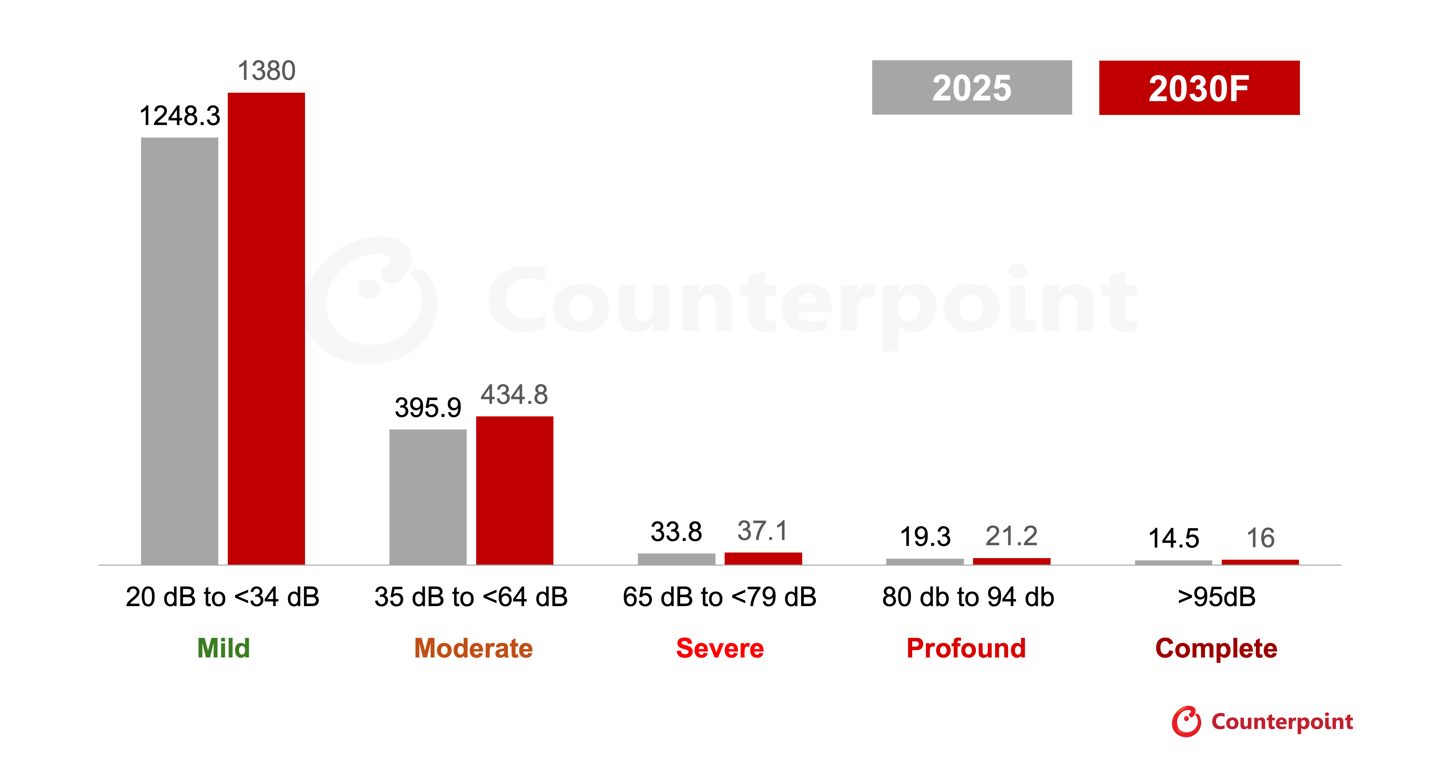
Counterpoint's Global On-Device AI Wearables Forecast projects global prescription hearing aid sales to top 31 million units by 2030, a 4% CAGR from 2025 to 2030, with nearly 50% of hearing aids carrying on-device AI by then. Hearing aids keep improving in size, connectivity and battery life, but the core problem persists: users struggle to follow speech in noisy places. Traditional aids rely on digital signal processing — microphones capture sound, a processor analyzes frequency and volume, and preset algorithms decide what to amplify — which handles steady noise like air conditioners but fails in complex scenes such as a crowded restaurant full of overlapping conversations. AI takes a different approach: instead of fixed rules, deep neural networks trained on millions of voice and noise samples identify the speaker in real time and suppress unrelated noise — separating voices, highlighting the target speaker, improving spatial awareness and continuously adapting. AI is especially good at distinguishing confusable sounds like s/f/t/sh/th, and numbers like fifteen vs fifty, so it improves real speech understanding in restaurants, meetings and busy streets rather than just raising the volume. In clinical speech-in-noise tests, normal-hearing listeners need roughly a 2 dB signal-to-noise ratio (SNR) to catch 50% of key words, rising to about 8 dB for mild-to-moderate hearing loss; per Phonak, fixed directional microphones add 6.4 dB over omnidirectional ones, and AI noise reduction raises the gain to 9 dB by default and 10.2 dB at maximum. Machine learning also makes aids more automatic and personalized, cutting listening effort and fatigue — but always-on neural networks cost battery and space: Phonak's Audéo Infinio Ultra Sphere lasts 56 hours in normal use yet only about 10 hours with AI constantly on. Latency is the hard constraint: processing must finish within about 10 milliseconds, so AI has to run locally on the aid rather than in the phone or cloud — the core value of on-device AI. The race for next-generation hearing aids is to run AI silently in the background, delivering clearer voices, lower listening effort and more personalization without draining the battery or growing the device.
IT之家 10 月 14 日消息,Counterpoint 《全球端侧 AI 可穿戴设备预测》报告指出, 到 2030 年,全球处方助听器销量预计将突破 3100 万台,2025 至 2030 年的年复合增长率为 4% 。随着 AI 在助听器领域的应用普及, 预计到 2030 年,近 50% 的助听器产品将搭载端侧 AI 能力 。 多年来,助听器在小型化、连接性、续航方面持续进步,但核心难题始终存在:用户在嘈杂环境中难以听清对话。传统助听器主要依赖数字信号处理(DSP):麦克风采集环境声音,处理器分析频率、音量等特征,再通过预设算法决定放大或降低哪些声音。这套方案对空调、发动机这类稳定噪音有效,但现实场景往往更复杂。比如拥挤餐厅中同时存在多段对话、音乐、餐具碰撞声,基于规则的系统很难判断用户真正想听的声音。 AI 带来了完全不同的解决方案: AI 模型不依赖预设规则,可通过学习区分人声与其他声音的模式 。经过数百万组人声与背景噪音样本训练的深度神经网络(DNN),可以实时识别说话者的声音,并抑制无关噪音。 AI 能够提升助听器在真实环境中的语音识别能力,通过分离人声和噪音、优先突出目标说话者、提升空间感知、持续适应环境变化实现优化。AI 尤其擅长区分「s」「f」「t」「sh」「th」这类细微易混的语音,还可以帮助用户区分 15 和 50、17 和 70(IT之家注:英语中的 fifteen 和 fifty 读音近似)这类数字,通过保留这些精细语音特征,AI 不仅能放大音量,还能提升餐厅、会议、拥挤街道等场景下的实际语音理解能力。 在临床「噪音中语音识别」测试中,听力正常的听众通常需要约 2 dB 的信噪比(SNR)才能正确识别 50% 的关键词;而对轻中度感音神经性听力损失听众来说,这一需求提升到约 8 dB,AI 正好能在信噪比上带来可量化的提升。根据峰力(Phonak)测试,固定指向麦克风搭配传统设置,相比全向麦克风可将信噪比提升 6.4 dB;加入 AI 降噪技术后,默认设置下提升幅度达到 9 dB,最大设置下可达 10.2 dB,足以让用户在餐厅场景中顺畅交流。 AI 还能让助听器更自动化、个性化:机器学习可以根据用户偏好和聆听场景自适应调整声音处理,减少手动调节,降低跟随对话所需的认知负荷,最终减少聆听疲劳、降低重复询问的需求、提升用户日常交流信心。不过这些提升并非没有代价:持续运行神经网络会消耗电池电量,也占用设备空间,因此当前最强的 AI 助听器往往仅提供少数款式选择。 助听器对处理延迟要求极高:从采集声音到处理完成再传入耳朵,整个过程必须控制在 10 毫秒或更短才能保证自然体验,这让助听器和大部分 AI 设备有着本质区别 —— 智能手机可以将数据上传到云端、等待 AI 返回结果再处理,但助听器无法承担云端往返延迟,哪怕微小延迟也会造成用户视听不同步,或让用户自身声音听起来不自然。 因此, 实时语音处理要求 AI 必须运行在助听器本地,而非用户手机或云端,这正是端侧 AI 的核心价值:声音在靠近麦克风和接收器的本地完成分析处理 。 难点在于,助听器本身电池容量极小、计算能力有限、尺寸约束严格,想要把 AI 能力塞进这样的设备,必须对 AI 模型和处理器做高度优化,才能在实现语音分离、降噪的同时将功耗控制到最低。持续运行神经网络会显著缩短续航:例如峰力 2025 款 Audéo Infinio Ultra Sphere,常规使用续航为 56 小时,如果持续开启 AI 功能,续航会骤降到 10 小时,这也直观展现了本地运行 AI 的成本。 集成端侧 AI 让助听器变得「智能」,但高效集成才是研发难点:每一点语音清晰度提升都要付出续航和空间代价,峰力产品的数据也直观展现了这一成本。下一代助听器的核心竞争力,就在于如何让 AI 在后台静默运行,在提供更清晰人声、更低聆听负荷、更个性化听力体验的同时,不消耗过多电量,也不增大设备体积,目前行业已经开启了这场技术竞赛。
想马上用起来?去「AI工具」栏挑一个直接下载,或在「AI教程」里跟着图文步骤做一遍。
去 AI工具 → 看 AI教程 →阅读与点赞数据保存在你的浏览器本地,欢迎留下你的想法。
 今日正能量学一点,用一点;今天种下的种子,会长成明天的能力。去免费下载专区 →广告
评论 文明发言,让讨论更有价值